

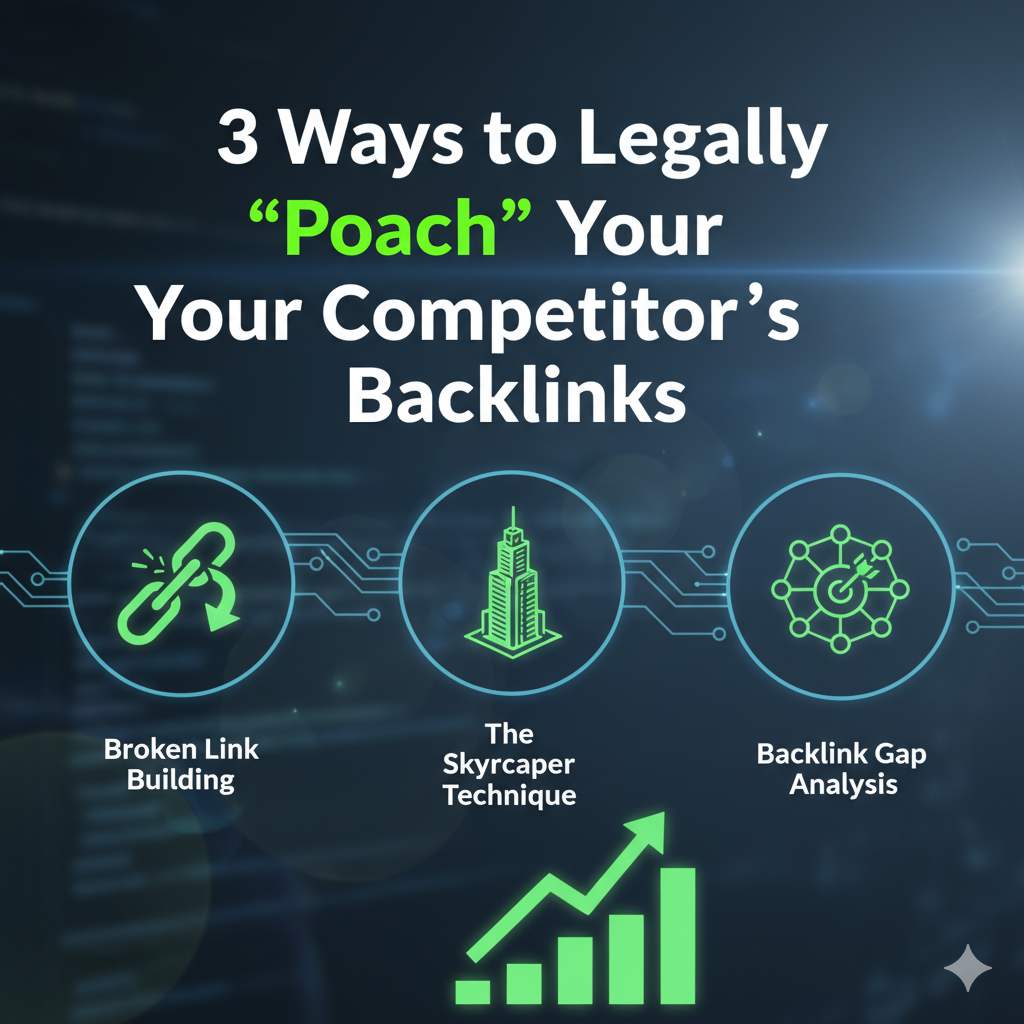
“Backlink poaching.” It sounds like something you do in the dead of night, wearing a black hat (SEO pun intended). It conjures up images of hacking, stealing, and all-around shady tactics.
I want to clear the air right now. What I’m about to show you is not that.
When I talk about “poaching,” I’m talking about strategic, data-driven, and 100% white-hat competitor analysis.
It’s not about “stealing” in the traditional sense. It’s about earning. It’s about finding opportunities that your competitors have already vetted for you and then strategically inserting yourself into the conversation.
Think about it: your competitors have spent thousands of dollars and countless hours identifying, vetting, and acquiring high-quality backlinks. They’ve essentially created a treasure map for you. They’ve proven that a specific website (let’s call it “Site X”) is willing to link to content in your niche.
Why on earth would you ignore that data?
Your goal isn’t to hack their site. Your goal is to look at that treasure map and say, “Ah, Site X links to this topic. I have content on that topic. In fact, my content is better.”
This isn’t just link building. This is efficient link building. You’re not just throwing darts in the dark; you’re targeting pre-qualified domains that have a proven history of linking to your direct rivals. You close the “backlink gap,” and in doing so, you close the ranking gap.
I’ve used these exact three methods to help clients in hyper-competitive niches (think finance, legal, and SaaS) climb the SERPs by systematically and ethically acquiring the types of links that were propping up their competition.
And today, I’m going to teach you how to do it, step-by-step.
Key Takeaways: What You’re About to Learn
Before we dive in, here’s a quick overview of the game plan. This isn’t just theory; this is a tactical playbook.
- You will learn what “backlink poaching” really means in a modern, white-hat SEO context. (Hint: It’s all about earned placement).
- You will get three distinct, actionable strategies to find and acquire links that are currently pointing to your competitors.
- You will learn how to use common SEO tools (like Ahrefs, Semrush, etc.) to do the heavy lifting, pinpointing the exact links to target.
- You will get sample outreach templates you can adapt, designed to maximize your response rate by being helpful, not spammy.
- You will understand the “why” behind each method, which will make you a smarter, more effective link builder.
Ready? Let’s get started.
Your Pre-Poaching Toolbox
You can’t do this job without the right tools. While you can try to do some of this manually, it’s like trying to build a house with just a hammer. An SEO suite is your power drill, your saw, and your level all in one.
You’ll need a subscription to one of the “big three”:
- Ahrefs: My personal favorite for backlink analysis. Its
Site ExplorerandLink Intersecttools are phenomenal. - Semrush: A very close second. Its
Backlink Gaptool is the direct equivalent ofLink Intersectand is incredibly powerful. - Moz: Their
Link Exploreris the classic, and their “Link Intersect” feature is also great for this.
For the rest of this article, I’ll be using Ahrefs terminology, but the principles are identical across all major platforms.
Method 1: The “Dead Link” Swap (A.K.A. Broken Link Building)
This is the most literal and direct form of “poaching.”
You are finding a link that used to go to your competitor, but that page is now dead (a 404 error). You then contact the site owner, let them know they have a broken link (you’re being helpful!), and suggest your content as the perfect replacement.
You win, you get a high-quality, relevant link.
The site owner wins, they get to fix a broken link on their site (which is good for their own SEO and user experience).
Your competitor… well, they already lost this link when their page died. You’re just cleaning up the mess.
Why This Method Is Pure Gold
Think about outreach. The number one reason outreach emails get ignored is that they’re a pure ask. “Hi, please give me a link. It helps me.”
Broken link building (BLB) flips the script. Your email starts with giving. “Hi, I’m a fan of your site and I noticed a small error you might want to fix.”
You’re not a spammer; you’re a helpful colleague. This single change in framing, according to research, can dramatically increase your success rate. While the average link building outreach email has a response rate of around 8.5%, a well-executed BLB campaign can see much higher numbers because it’s rooted in providing immediate value.
Your Step-by-Step BLB Poaching Plan
- Find Your Targets: Identify your top 3-5 direct SEO competitors. These are the people ranking for the keywords you want to rank for.
- Analyze Their Backlinks:
- Go to Ahrefs’
Site Explorerand enter your competitor’s domain. - Go to the “Backlinks” report.
- In the filters, select “Broken” under the “Link type” or filter by “HTTP code” -> “404 not found.”
- Go to Ahrefs’
- Export Your Hit List: You’ll now have a list of every single website that is linking to a dead page on your competitor’s site. Export this list to a CSV.
- Find the “Golden” Opportunities: Sift through your list. You’re looking for links from high-authority, relevant websites (check the Domain Rating or “DR”). A single high-DR link from a relevant blog is worth 100 low-quality links.
- Match and Create: Look at the context of the link.
- What was the original page about? (You can often find this by plugging the dead URL into the Wayback Machine).
- Do you have a piece of content that is a perfect (or better) replacement?
- If you don’t, create it. This is key. You can’t just pitch your homepage. It has to be a 1-to-1 replacement for the value the old, dead article provided.
- The Outreach: This is where the magic happens. Find the contact info for the editor or webmaster of the site. Then, send a simple, non-pushy email.
Sample Email Template: The “Dead Link” Swap
Subject: Broken Link on Your [Article Title] Page
Hi [Webmaster Name],
I was doing some research on [Topic] today and came across your excellent article: [Link to their article].
I absolutely loved your point about [mention something specific and genuine].
I just wanted to give you a quick heads-up that one of the links on that page seems to be broken. It’s the one where you’re linking to [Competitor’s Anchor Text]. It just leads to a 404 error page.
I actually just published a new guide on that exact topic: [Link to YOUR article]. It’s fully up-to-date for 2025 and covers [mention a key point].
No pressure at all, but I thought it might make a great replacement for that broken link.
Either way, keep up the amazing work!
Best,
[Your Name]
Boom. You’re helpful, respectful, and you’ve offered a perfect solution.
Method 2: The “Better Content” Upgrade (A.K.A. The Skyscraper Technique)
This method, originally coined by Brian Dean of Backlinko, is the high-effort, high-reward champion of link building.
The concept is simple:
- Find competitor content that has already attracted a lot of high-quality links.
- Analyze why it got those links and find its weaknesses.
- Create a piece of content that is demonstrably better in every way (the “Skyscraper”).
- Reach out to the exact same people who linked to your competitor’s “inferior” content and show them your “upgrade.”
This isn’t just poaching a single link; it’s poaching the entire link profile of a competitor’s star player.
Why This Method Dominates in 2025
This technique is more relevant today than ever. Google’s entire algorithm is now geared towards E-E-A-T (Experience, Expertise, Authoritativeness, Trustworthiness) and “Helpful Content.”
You can’t just make something longer. “Better” in 2025 means:
- More Up-to-Date: Does their 2023 guide have outdated stats? Your 2025 guide will have fresh data.
- Better Design & UX: Is theirs a “wall of text”? Yours will have custom graphics, interactive elements, and maybe an embedded video.
- More Comprehensive: Did they miss a crucial part of the topic? You’ll cover it.
- More Expertise: Did they write a generic overview? You’ll include unique insights, original data, or quotes from experts.
You’re making the webmaster’s “job” easy. By linking to you, they’re upgrading their own article and providing more value to their readers.
Your Step-by-Step Skyscraper Plan
- Find the “Skyscraper” Targets:
- Go to Ahrefs’
Site Explorerand enter a competitor’s domain. - Go to the “Top content” report (or “Best by links”). This shows you their most-linked-to pages.
- Look for a piece of content (a blog post, a guide, a study) that is relevant to you and has a ton of “Referring Domains.”
- Go to Ahrefs’
- Analyze the “Why”: Open that article. Open the top 20 links pointing to it. Why did they link? Was it a unique statistic? A “how-to” guide? A case study? You need to understand the linkable asset itself.
- Build Your 10x Content: Now, go create something that makes their article look like a rough draft.
- Bad: “Their post was 1,500 words. I’ll write 2,000.”
- Good: “Their post has 5 tips. I’ll make a 10-tip guide with custom illustrations, a 3-minute summary video, and a downloadable checklist.”
- Build Your “Hit List”: Go back to Ahrefs. Open the report for your competitor’s article and click on “Backlinks.” Export that full list. This is your outreach list.
- The Outreach: This email needs to be confident but not arrogant. The key is to gently position your content as the new, better standard.
Sample Email Template: The “Better Content” Upgrade
Subject: Your article on [Topic]
Hi [Webmaster Name],
I’m working on a piece about [Topic] and I was looking for resources. I found your post: [Link to their article].
I saw you linked to the [Competitor’s Article Title] guide. A great resource!
I actually used that post as inspiration for a new, more comprehensive guide I just published. It’s called [Your Article Title] and it includes [mention 1-2 key differentiators, e.g., “original 2025 data and interviews with 3 industry experts”].
You can see it here: [Link to YOUR article]
I’m biased, of course, but I think it might be a valuable addition for your readers.
Cheers,
[Your Name]
This is a soft pitch. A more direct version might add: “If you agree, I’d be honored if you’d consider swapping the link.” I prefer to start soft.
Method 3: The “Me Too” Insertion (A.K.A. Backlink Gap Analysis)
This is my personal favorite because it’s the most efficient.
The idea is to find websites that link to multiple of your competitors, but not to you.
Think about that. If a website links to Competitor A, Competitor B, and Competitor C, they have explicitly demonstrated:
- They are in your niche.
- They are willing to link to sites exactly like yours.
- They are probably a “resource,” “list,” or “best of” page.
You’re not asking them to replace a link. You’re just asking to be included. You’re the missing piece of their otherwise comprehensive list! This is the lowest-friction ask you can possibly make.
Why This Method Is So Efficient
You’re not hunting for one-off links. You’re finding “link hubs”—pages designed to aggregate and link out to the best resources. Getting on one of these pages can be worth 10 normal links. You’re tapping into a pre-built ecosystem.
Your Step-by-Step Backlink Gap Plan
- Find the Gap:
- In Ahrefs, go to “Link Intersect” (in Semrush, it’s “Backlink Gap”).
- In the top field (“Show who is linking to…”), put in the domains of 2-3 of your top competitors.
- In the bottom field (“…but doesn’t link to”), put your domain.
- Hit “Show link opportunities”: Ahrefs will now churn and produce a list of all the domains that link to all (or some) of your competitors, but not to you.
- Analyze the Opportunities: Look at this list. You will instantly see patterns. You’ll find:
- “Top 20 [Your Industry] Blogs to Follow”
- “[Your Niche] Resource Page”
- “Best [Your Product] Tools”
- …all of which list your competitors, but not you. It’s like they left a spot open just for you.
- Find Your Angle: Click through to the page. Read it. Where would your site naturally fit? Don’t pitch your homepage if they’re linking to specific blog posts. Find your most relevant piece of content.
- The Outreach: This is the easiest pitch of all. You’re just helping them make their list more complete.
Sample Email Template: The “Me Too” Insertion
Subject: A (quick) addition to your [Page Title] list?
Hi [Webmaster Name],
I was searching for the best [Your Niche] resources today and found your amazing list: [Link to their article].
What a fantastic roundup! I noticed you included [Competitor A] and [Competitor B], which we’re big fans of.
I wanted to (respectfully) suggest our own [Product/Resource] for your consideration as well. We’re [Your Company Name], and we [provide a 1-sentence value prop that’s relevant to their list].
You can check us out here: [Link to YOUR most relevant page]
We’d be thrilled to be included alongside the other great names on your list.
Thanks for your time!
Best,
[Your Name]
Comparison of Legal “Poaching” Methods
To make it even easier, here’s a quick table comparing the three strategies.
| Method | Primary Goal | Effort Level | Estimated Success Rate | Key Tool Feature |
| 1. Broken Link Building | Replace a competitor’s dead link with your live link. | Medium | High (You’re being helpful) | Backlinks -> “Broken” |
| 2. Skyscraper Technique | Replace a competitor’s live link with your better link. | Very High | Medium (Requires 10x content) | Top content or Best by links |
| 3. Backlink Gap | Get added alongside competitors on resource pages. | Medium | Very High (It’s a low-friction ask) | Link Intersect or Backlink Gap |
FAQ
You’ve got the methods, but I’m sure you still have questions. These are the top 10 questions I get from my clients when I present this strategy.
1. What’s the difference between “dofollow” and “nofollow” links?
A “dofollow” link (the default) passes “link equity” or “PageRank” to your site. This is what you want for SEO. A “nofollow” link has a tag that tells Google not to pass that equity. While “nofollow” links from high-traffic sites (like Forbes or Wikipedia) can still drive traffic and build brand authority, for these “poaching” strategies, you are 99% focused on acquiring “dofollow” links.
2. How many links do I need?
This is the wrong question. It’s not about quantity; it’s about quality. One single “dofollow” link from a hyper-relevant, high-authority site (like an industry-leading blog) is worth more than 1,000 spammy, low-quality links. Focus on closing the gap on your competitors’ best 10-20 links, not all 10,000 of them.
3. Will Google penalize me for this?
Absolutely not. At no point are you hacking, buying links, or participating in a link scheme. You are doing content marketing and outreach. You are creating valuable content and then emailing people to tell them about it. This is the exact kind of “earned media” Google wants to reward.
4. How much does this cost?
The “cost” is time and tools. A subscription to Ahrefs or Semrush is non-negotiable (approx. $100-$200/mo). The real cost is the human time—the time to research, create 10x content, find contacts, and do personalized outreach. This is why agencies charge thousands for it. But you can 100% do it yourself.
5. How do I find the webmaster’s email address?
This is the art of “prospecting.” Sometimes it’s on their “Contact” or “About” page. More often, you’ll need a tool like Hunter.io or Snov.io. These are browser extensions that can find email addresses associated with a domain.
6. I sent 20 emails and got no replies. What’s wrong?
First, outreach is a numbers game. An 8.5% response rate is average. That means ~18 of your 20 emails will be ignored. Second, your email might be the problem. Was it personalized? Did you use their name? Or did you send a generic, copy-pasted template? Personalization is everything. My rule: if it looks like a mass email, it will be treated like one (i.e., deleted).
7. Should I follow up on my outreach emails?
Yes. One hundred percent. People are busy. Inboxes are full. A single, polite follow-up 3-4 days later is not pushy; it’s professional. A simple, “Hey [Name], just wanted to make sure you saw my email below,” is often all it takes. This can double your response rate.
8. What makes a “high-quality” link?
Three things:
- Relevance: Is the linking site in your niche? A link from a fellow marketing blog is 100x better than a link from a random pet food blog.
- Authority: Does the site have its own strong backlink profile and good rankings? (This is what Ahrefs’ “DR” or Moz’s “DA” tries to measure).
- Context: Is the link placed naturally within the body of an article? A contextual link is far more valuable than a link in a footer or a giant directory.
9. Why can’t I just buy links?
You can, but you will get caught. Buying links is a direct violation of Google’s Webmaster Guidelines. When Google finds out (and they will), your site will be hit with a manual penalty, and your rankings will disappear overnight. It’s playing with fire. Everything I’ve shown you today is the long-term, sustainable, correct way to do it.
10. How long until I see results?
Link building is a marathon, not a sprint. After you acquire a link, it can take Google weeks or even months to re-crawl that page, index the link, and pass that new authority to your site. You won’t do this on Monday and rank #1 by Friday. But if you do this consistently for 6-12 months, the compound effect on your rankings will be undeniable.
Final Thoughts: Go Earn Your Place
The term “poaching” is just a hook. What we’ve really been talking about is competitive intelligence.
You now have a complete playbook to find out what’s working for your competition and use that data to build a smarter, more efficient, and more powerful link building strategy of your own.
You’re not stealing. You’re not cheating. You’re finding the people who are already linking to your competitors and earning your place in the conversation—either by being helpful (BLB), by being better (Skyscraper), or by being the missing piece (Link Gap).
This is advanced, active, white-hat SEO. It takes work, but it’s the only way to build a sustainable, long-term advantage.
Now, go open up your Ahrefs account and start building that first “hit list.”
